

Fire-Rated Insulation Materials: What Nepali and Indian Building Codes Require
A practical overview of fire-rating requirements for insulation materials under Nepal's National Building Code and comparable Indian standards.
Fire safety requirements for insulation are frequently overlooked until a municipal inspection flags them — here's what Nepal's National Building Code (NBC) and comparable Indian National Building Code (NBC India) provisions generally expect.
Why insulation fire rating matters
Many common insulation materials (certain foams, some adhesives) are combustible and can accelerate fire spread through wall cavities and ceiling voids if used without a fire-rated barrier — this is a leading cause of rejected inspections on commercial projects.
Non-combustible options
Rockwool (mineral wool) is Class A1 non-combustible and is the default specification for fire-rated partitions, escape routes and high-occupancy buildings across both Nepal and India. Fire-rated gypsum board is typically paired with it for wall assemblies.
Where combustible insulation is still used
EPS and standard PU foam boards are combustible but remain widely used for non-structural, non-escape-route applications like general wall/roof insulation, provided they're specified with an appropriate fire-retardant grade and don't form part of a fire compartment wall.
Documentation to keep
For commercial and multi-storey projects, always retain the manufacturer's fire test certificate for the specific product and thickness used — inspectors in both Nepal and India increasingly ask for this rather than accepting a generic 'fire-retardant' label on the packaging.
Practical takeaway
Specify non-combustible insulation for anything near an escape route, stairwell or fire-rated wall, and reserve combustible options for open, non-critical areas — check fire protection solutions for compliant material options.
NepalBuild Admin
Content Team · BuildMartNepal.com — Nepal's construction materials marketplace
Similar articles
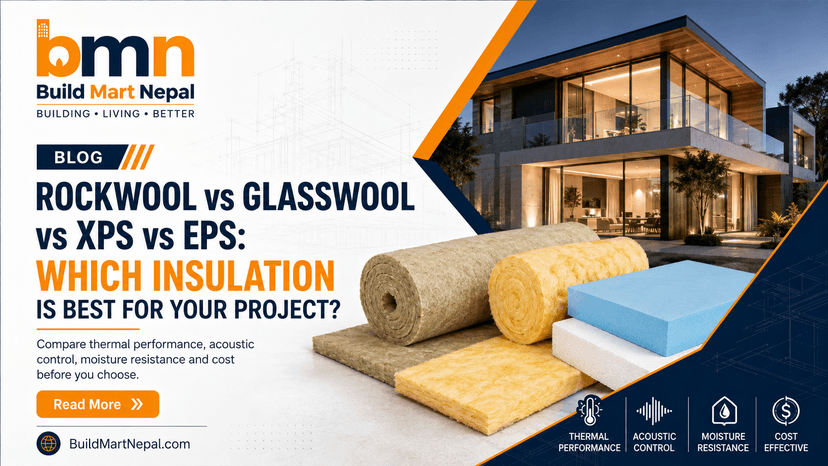
Rockwool vs Glasswool vs XPS vs EPS: Which Insulation Is Best for Your Project?
Comparing thermal performance, acoustic control, moisture resistance and cost across the four most common insulation materials sold in Nepal.

PUF Panels vs Traditional Brick Walls: Speed and Cost Compared for South Asia
Prefabricated PUF sandwich panels are reshaping fast-track construction across Nepal, India and neighboring markets — here's how they actually compare to brick.

Thermal Insulation for Hot Climates: Lessons from Nepal's Terai and India
Insulation isn't just for cold regions — how Nepal's Terai belt and Indian cities use thermal insulation to cut cooling costs.
Rockwool vs Glasswool Insulation: Which Is Best for Nepal's Climate?
A side-by-side comparison of the two most common thermal and acoustic insulation materials sold in Nepal, India and the wider South Asian market.